

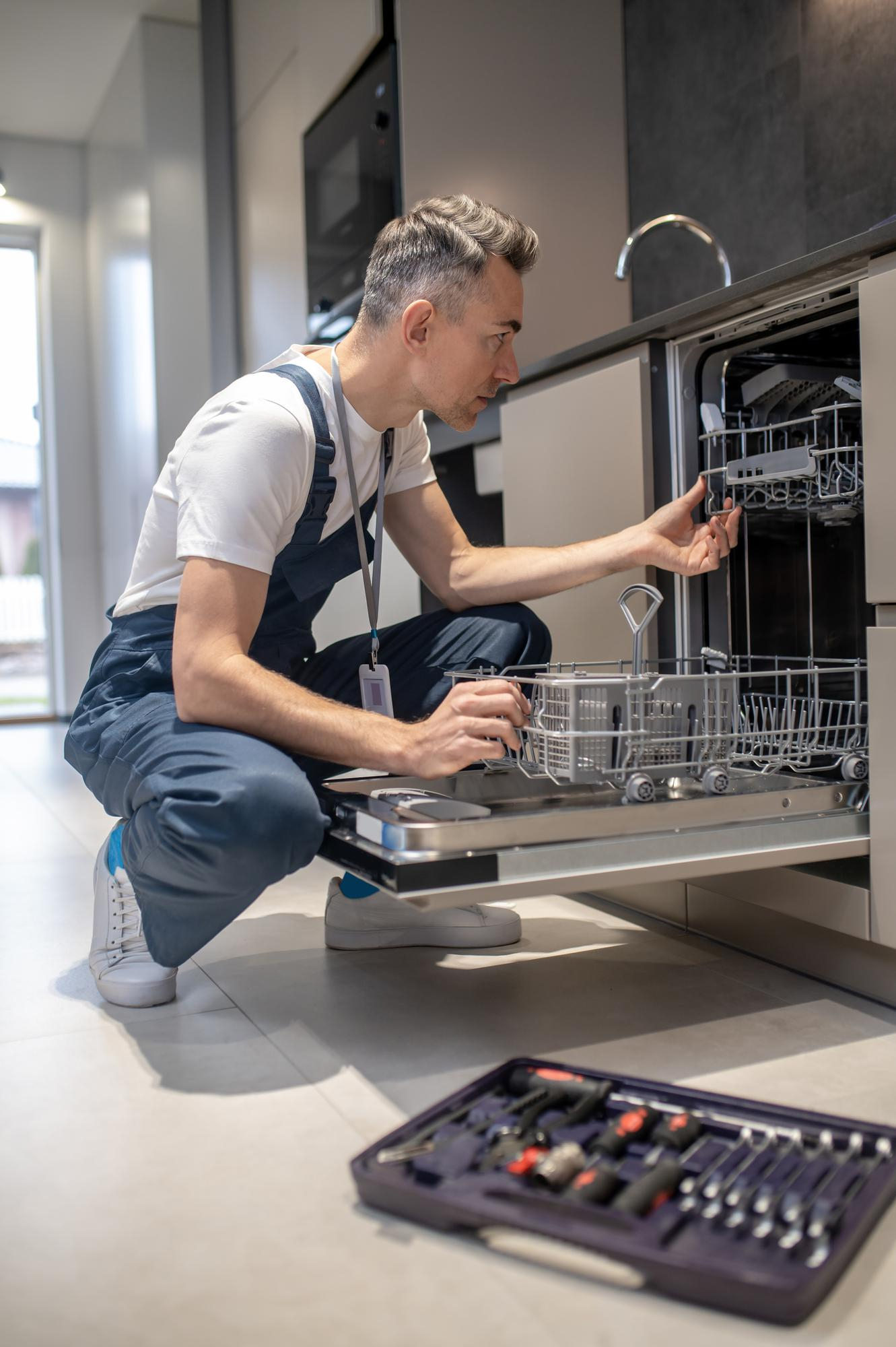
Opening the dishwasher to find dirty water sitting in the bottom is one of the most common appliance problems we see. The good news: in many cases the cause is a clogged filter or a blocked drain path that you can clear yourself in a few minutes. This guide walks you through the most likely causes in the order a technician checks them, what you can safely do at home, and when it is time to call for dishwasher repair.
Quick Answer: Why Is My Dishwasher Not Draining?
The most common reasons a dishwasher won’t drain are:
- A clogged filter at the bottom of the tub
- A kinked or blocked drain hose
- A new garbage disposal with the knockout plug still in place
- A clogged air gap or sink drain
- Debris jammed in the drain pump
- A failed drain pump
- A stuck check valve or a control problem
Start with the first four. They cause most drain problems and need no tools.
Before You Start: Safety First
- Turn the dishwasher off and switch off its breaker before reaching inside.
- Put towels on the floor and keep a bowl and a cup handy to scoop out water.
- Be careful around the filter and sump. Broken glass often ends up there.
1. Clean the Dishwasher Filter
Most modern dishwashers have a cylindrical filter under the lower spray arm. Food, labels, seeds, and grease collect there and slow drainage until water stays in the tub.
- Remove the bottom rack.
- Twist the filter counter-clockwise and lift it out (check your manual if it looks different).
- Rinse it under warm water and scrub it gently with a soft brush and a little dish soap.
- Look into the opening below the filter and remove any debris you can see.
- Reinstall the filter until it locks in place.
A dirty filter is the single most common reason for standing water. Cleaning it once a week or every two weeks prevents most drain problems.
2. Check the Drain Hose
The drain hose runs from the dishwasher to the sink drain or garbage disposal under the sink. If it is kinked, crushed behind the dishwasher, or clogged with food, water can’t leave the tub.
- Look under the sink for sharp bends or anything pressing on the hose.
- Make sure the hose has a high loop, fastened up under the counter, or runs through an air gap. Without it, dirty sink water can flow back into the dishwasher.
- If you are comfortable doing so, disconnect the hose at the sink end (with a bowl underneath) and check it for blockages.
3. New Garbage Disposal? Check the Knockout Plug
If the drain problem started right after a new garbage disposal was installed, this is almost certainly the cause. New disposals come with a plastic plug inside the dishwasher inlet that has to be knocked out during installation. If it wasn’t, the dishwasher has nowhere to drain. The plug must be removed from inside the disposal inlet. Disconnect power to the disposal first.
4. Clear the Air Gap and the Sink Drain
Some kitchens have a small chrome cap on the countertop next to the faucet. That is the air gap. Food can clog it, and water may spray out of it during draining.
- Pull or twist off the cap and clean out any debris.
- Run the garbage disposal for a few seconds, since it shares the drain with the dishwasher.
- Check that the kitchen sink itself drains quickly. A slow sink means the clog is in the house plumbing, not the dishwasher.
5. Debris in the Drain Pump
If the filter and hose are clear but water still won’t drain, something may be jammed in the drain pump: a piece of glass, a bone, a cherry pit, or a plastic tag. You may hear a hum or a buzz but little water moving.
On many models the pump cover sits under the filter. With the power off and the water scooped out, you may be able to see and remove the object. If you can’t reach it, or you see the pump impeller is damaged, it is time for a technician.
6. A Failed Drain Pump
Drain pumps wear out. Signs of a failing pump include:
- A humming sound during the drain cycle but no water leaving
- No sound at all when the dishwasher should be draining
- Water that drains very slowly even with a clean filter and hose
A technician tests the pump’s power supply and windings to confirm whether the pump has failed or the control board isn’t sending power to it.
7. Check Valve or Control Problems
A check valve stops dirty water from flowing back into the tub. If it sticks closed, water can’t leave. Less often, a faulty control board, door switch, or float switch stops the drain cycle from running. These need testing with a meter and are best left to a professional.
Common Drain Error Codes
Many dishwashers show a code when they can’t drain. A few common examples:
- Bosch: E24 (drain hose or filter blocked) and E25 (drain pump blocked)
- LG: OE (drain error)
- Samsung: 5C or 5E (drain error, depending on the model)
Write the code down before resetting the dishwasher. It helps the technician narrow down the problem. If you own a Bosch, see our Bosch appliance repair page.
What Not to Do
- Don’t pour chemical drain cleaners into the dishwasher. They can damage seals and the pump.
- Don’t keep running cycles with water sitting in the tub. The drain pump can overheat.
- Don’t use dish soap in the dishwasher. The suds can stop it from draining and cause leaks.
When to Call a Technician
Call for help if:
- The filter, drain hose, air gap, and sink drain are all clear and water still stays in the tub
- You hear humming or grinding during the drain cycle
- There is a drain error code that comes back after a reset
- Water is leaking onto the floor (see dishwasher leaking)
Not sure what to prepare before the visit? Our guide on how to prepare for a dishwasher repair walks you through it.
How to Prevent Drain Problems
- Scrape plates into the garbage before loading them.
- Clean the filter every one to two weeks.
- Run the garbage disposal before starting the dishwasher.
- Use dishwasher detergent only, in the right amount.
- Run hot water at the sink for a few seconds before starting a cycle.
Dishwasher Repair in Thornhill, Vaughan and Toronto
If your dishwasher still won’t drain, Speedy Appliance Repair can help. We have repaired dishwashers across Thornhill, Vaughan, Richmond Hill, North York, and Toronto since 2011. We offer same-day visits, and when the part is in our van, the repair is usually done the same day or the next day.
- Open 24/7, including evenings and weekends
- Free service call when you go ahead with the repair
- Genuine manufacturer parts
- 90-day parts and labour warranty
- Insured technicians who wear shoe covers and leave the kitchen clean
Book a dishwasher repair or call (416) 900-3677.
Frequently Asked Questions
Is it normal to have a little water in the bottom of the dishwasher?
A small amount of water around the filter is normal on many models; it keeps the seals moist. Water covering the bottom of the tub after a cycle is not normal and means the dishwasher isn’t draining properly.
Can I run the dishwasher if it is not draining?
It is better not to. Running cycles with standing water can overheat the drain pump, cause leaks, and leave dirty water on your dishes.
How do I drain standing water from my dishwasher?
Turn off the power, place towels on the floor, then scoop the water out with a cup and soak up the rest with a sponge or towel. After that you can remove and clean the filter.
Why does my dishwasher not drain after a new garbage disposal was installed?
The knockout plug in the disposal’s dishwasher inlet was probably not removed. Once it is knocked out, the dishwasher can drain normally.
Is it worth repairing a dishwasher that won’t drain?
Usually, yes. Most drain problems come from a clog or a drain pump, which are much cheaper to fix than replacing the dishwasher, especially on a newer or higher-end model.